For ecommerce brands navigating the ever-shifting sands of digital advertising, the landscape of 2026 presents both formidable challenges and unprecedented opportunities. The familiar battlegrounds of Meta and Google, once fertile ground for scalable growth, are increasingly saturated, driving up Customer Acquisition Costs (CAC) and eroding profit margins. Yet, amidst this competitive intensity, a new frontier has emerged: OpenAI Ads. On May 5, 2026, OpenAI officially launched its self-serve Ads Manager, democratizing access to advertising within ChatGPT and fundamentally altering the calculus for performance marketers.
This isn’t merely another ad platform; it’s a land grab. For Shopify brands, understanding and leveraging OpenAI Ads today represents a critical strategic advantage. Early adopters stand to capture high-intent buyers at significantly lower costs, establishing a foothold before the inevitable influx of competition. Our experience across numerous platform launches consistently demonstrates that the initial 90 days on a nascent ad channel are disproportionately impactful, setting the trajectory for long-term success. This guide will meticulously unpack the mechanics of the OpenAI ad auction, elucidate the profound benefits of early entry, and outline a precise, actionable 90-day launch strategy designed for maximum impact.
The Conversational Shift: Why OpenAI Ads Are Different
The fundamental premise of OpenAI Ads diverges sharply from traditional platforms. While Meta thrives on interruption-based discovery and Google on explicit search intent, OpenAI Ads operates within the context of conversational AI. Users engaging with ChatGPT are often in a research or problem-solving mindset, actively seeking information, recommendations, or solutions. This inherent intent transforms the advertising experience from a passive impression into a contextual interaction.
Consider the user journey: instead of typing a keyword into a search bar, they might ask ChatGPT, “What are the best sustainable activewear brands for high-intensity workouts?” or “Help me find a durable, lightweight backpack for a multi-day hiking trip.” Ads served within these conversations are not intrusive banners but rather contextually relevant suggestions, seamlessly integrated into the dialogue. This makes the audience inherently more qualified and receptive, leading to higher engagement and conversion potential.
The Land-Grab Thesis: Capitalizing on the Empty Auction
The history of digital advertising is replete with examples of platforms that began with abundant, inexpensive inventory, only to see costs skyrocket as advertiser demand caught up. Facebook in its early days, and TikTok more recently, offered unprecedented ROAS for those who moved swiftly. OpenAI Ads is currently in this nascent, highly advantageous phase.
As of mid-2026, the ChatGPT Ads Manager, despite dropping its prohibitive minimum spend requirements and opening to all US businesses, remains relatively uncrowded. Many brands are adopting a wait-and-see approach, hesitant to invest in an unproven channel. This collective hesitation creates a strategic vacuum that astute ecommerce marketers can exploit. The current Cost Per Click (CPC) for ChatGPT ads typically ranges from $3 to $5, with Cost Per Mille (CPM) fluctuating between $25 and $60, depending on the specific category and audience [3]. While these figures might seem comparable to mature platforms, the crucial distinction lies in the quality of intent and the lack of competitive pressure.
Table 1: OpenAI Ads vs. Established Platforms (Early 2026)
| Feature | OpenAI Ads (Early 2026) | Meta Ads (Mature) | Google Search Ads (Mature) |
| Auction Competition | Nearly Empty | Saturated | Saturated |
| Buyer Intent | High (Mid-Research) | Interruption-Based | High (Explicit Search) |
| Average CPC/CPM | Low (Pre-Competition) | High & Rising | High & Rising |
| Creative Focus | Conversational Copy | Visuals & Video | Keyword-Driven Text |
| First-Mover Advantage | Significant | Minimal | Minimal |
This window of opportunity is finite. As more brands recognize the potential of conversational commerce and the efficacy of OpenAI Ads, competition will inevitably intensify, driving up costs. Brands that establish their presence now will benefit from:
- Cheaper Clicks & Impressions: Lower initial bids translate to more reach and traffic for the same budget.
- Data Accumulation: Early data allows for faster algorithm learning and optimization, creating a compounding advantage.
- Brand Association: Positioning your brand as an innovator in the AI commerce space.
- Refined Playbooks: Developing proprietary strategies and creative approaches before competitors.
Deconstructing the OpenAI Ad Auction: Relevance is King
To truly master OpenAI Ads, a deep understanding of its auction mechanism is paramount. Unlike simplistic models where the highest bidder always wins, OpenAI employs a relevance-weighted, second-price auction. This sophisticated system prioritizes user experience and contextual alignment above raw bid amounts.
In essence, your ad’s ability to resonate with the user’s current conversation carries significant weight. A meticulously crafted ad that directly addresses the user’s query or need, even with a modest bid, can outperform a higher-bidding, less relevant advertisement. This means that creative quality and contextual targeting are as, if not more, important than budget size.
Conversational Targeting: Beyond Keywords
The absence of direct keyword bidding, as seen in Google Search Ads, is a defining characteristic of OpenAI Ads. Instead, targeting relies on conversational adjacency. The AI analyzes the ongoing dialogue, inferring user intent and context, and then matches it with relevant ad creatives. This requires a shift in mindset for advertisers:
- From Keywords to Context: Focus on the broader themes, problems, and aspirations expressed in conversations, rather than isolated search terms.
- From Static to Dynamic: Ad creatives must be adaptable and responsive to the nuances of conversational flow.
- From Product Features to Solutions: Emphasize how your product solves a problem or fulfills a need within the conversational context.
However, a critical nuance exists: OpenAI, for privacy reasons, does not share the raw user prompt content with advertisers. This means that while the AI understands the context to serve the ad, marketers do not have direct access to the pre-click intent. This limitation elevates the importance of robust post-click measurement and optimization, making your tracking infrastructure the single most vital component of your campaign success.
The Tracking Imperative: Why Server-Side is Non-Negotiable
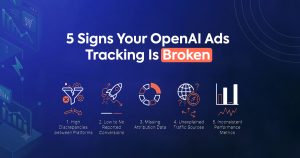
The Achilles’ heel of many early OpenAI Ad campaigns will be inadequate tracking. The platform’s algorithm, like any machine learning system, optimizes based on the data it receives. Feed it incomplete or inaccurate conversion data, and it will inevitably scale the wrong audiences, leading to wasted spend and suboptimal performance.
In 2026, traditional browser-based pixels are increasingly unreliable. The proliferation of ad blockers, stringent iOS privacy features (such as Intelligent Tracking Prevention), and the inherent complexities of checkout redirects on platforms like Shopify can silently drop up to a third of all browser-side conversion events. If your OpenAI Ad campaigns are only registering 65-70% of your actual sales, your reported Return on Ad Spend (ROAS) will be artificially deflated, and the algorithm will struggle to identify and target your most valuable customers.
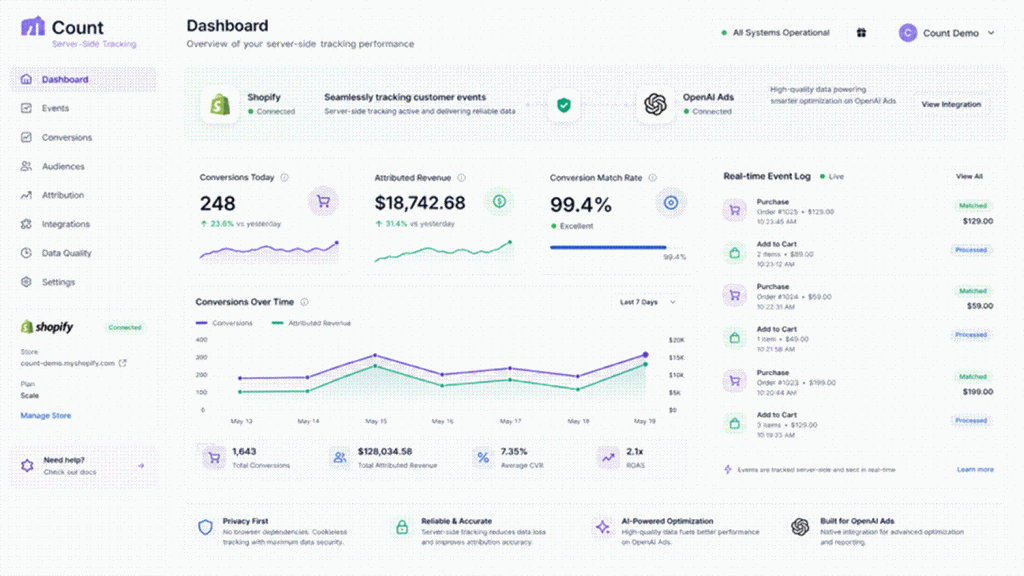
To circumvent these limitations and ensure data fidelity, server-side tracking is not merely a best practice; it is a prerequisite for success on OpenAI Ads. By implementing a server-side pixel and leveraging OpenAI’s Conversions API (CAPI), conversion data is sent directly from your Shopify store’s servers to OpenAI, bypassing browser-side restrictions entirely. This guarantees that the algorithm receives a near 100% accurate stream of purchase data, enabling precise optimization and maximizing your ROAS.
Table 2: Conversion Tracking Methods Comparison
| Tracking Method | Conversion Match Rate (vs. Actual Sales) | Vulnerability to Ad Blockers/Privacy | Data Accuracy | Optimization Capability |
| Browser Pixel | ~64% | High | Low | Limited |
| Server-Side (CAPI) | 99.4%+ | None | High | Optimal |
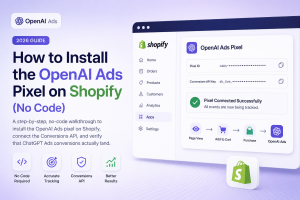
This is precisely where solutions like Count become indispensable. Count installs the OpenAI Ads pixel server-side on your Shopify store with a single click, ensuring every sale is accurately attributed and fed back to the OpenAI algorithm. This foundational accuracy is the bedrock upon which profitable, scalable campaigns are built Learn more about server-side conversion tracking with Count.
Crafting Winning Campaigns: A 90-Day Early-Mover Playbook
Success on OpenAI Ads requires a deliberate, phased approach. Resist the urge to simply port over existing campaign structures from other platforms. The conversational nature of ChatGPT demands a tailored strategy. Here’s a detailed 90-day roadmap for ecommerce brands:
Days 1-14: The Foundation – Tracking, Catalog, and Creative Strategy
Objective: Establish flawless tracking and prepare your assets for conversational commerce.
- Implement Server-Side Tracking: Before spending a single dollar, ensure your OpenAI Ads pixel is installed server-side and verified. Utilize tools like Count to guarantee 99%+ conversion match rates and accurate event deduplication. Verify that page views, add-to-carts, and purchases are flowing correctly and in real-time.
- Optimize Your Product Catalog: ChatGPT’s conversational interface means product discovery is driven by context, not just keywords. Review your product titles, descriptions, and imagery. Reframe them to answer common questions, highlight benefits, and address pain points that users might express in a conversation. Think: “How would a customer ask ChatGPT to find this product?” rather than “What keywords describe this product?”
- Develop Conversational Creative Guidelines: Begin brainstorming ad copy that feels native to a chat environment. Avoid overly promotional or salesy language. Focus on being helpful, informative, and subtly persuasive. Consider different conversational entry points and how your ad can naturally extend the dialogue. What converts on a visual platform like Instagram will likely fall flat in a text-heavy, conversational context.
Days 15-45: Controlled Launch – Testing and Learning
Objective: Launch initial campaigns, gather data, and identify early winners.
- Start with Controlled Budgets: Begin with conservative daily budgets. The goal in this phase is learning, not immediate scale. Monitor performance closely, focusing on click-through rates (CTR), initial conversion rates, and the quality of traffic.
- Experiment with Ad Formats: OpenAI Ads supports various formats, including text-based conversational ads and potentially richer media within the chat interface. Test different variations to see what resonates most effectively with your target audience within the conversational flow.
- Iterate on Ad Copy: Based on early performance data, continuously refine your ad copy. Pay attention to which messages drive engagement and conversions. Remember, the auction heavily favors relevance, so a higher CTR often translates to lower CPCs.
- Monitor Performance Metrics: Beyond standard metrics, pay close attention to how users interact post-click. Are they adding to cart? Initiating checkout? The server-side tracking will provide the accurate data needed to make informed decisions.
Days 46-90: Scale and Refine – Optimization and Expansion
Objective: Scale winning campaigns and expand your presence on the platform.
- Identify and Scale Winners: By week six, with accurate server-side data, you should have a clear understanding of which campaigns, ad sets, and creatives are performing best. Aggressively shift budget towards these winners.
- Aggressive A/B Testing: Continuously test new ad copy, calls to action, and potentially new product offerings. The conversational nature of the platform means there’s always room to optimize how you engage users.
- Explore Advanced Targeting (as available): As OpenAI’s Ads Manager matures, features like Audience Tools (for first-party data uploads) and Creative Tools (for AI-generated ad variations) will become available [6]. Be ready to integrate your customer data to create highly segmented custom audiences and leverage AI to rapidly generate and optimize ad creatives.
- Integrate with Shopify Agentic Storefronts: For Shopify merchants, ensure your product catalog is fully optimized for Agentic Storefronts. This integration allows your products to be seamlessly surfaced within ChatGPT and other AI platforms, turning conversational queries into direct sales opportunities [7].
The Future is Conversational: Don’t Get Left Behind
OpenAI Ads represents a pivotal shift in the digital advertising landscape. It’s a rare confluence of high-intent audience, low competition, and a fundamentally new interaction paradigm. The brands that embrace this shift now, prioritizing robust tracking and conversational creative, will unlock a significant competitive advantage.
The window for this early-mover advantage is rapidly closing. As more ecommerce businesses recognize the immense potential, the auction will inevitably become more competitive. Delaying your entry means higher costs, a steeper learning curve, and the forfeiture of invaluable first-party data and optimization insights.
If the technical complexities of setting up server-side tracking or navigating a new ad platform seem daunting, remember that specialized solutions and services exist. The team behind Count, for instance, not only provides the essential server-side tracking pixel for Shopify but also offers done-for-you management services for OpenAI Ads campaigns, ensuring brands can capitalize on this opportunity without internal resource strain Get a free OpenAI Ads Readiness Audit today.
Stop optimizing on incomplete data. Start scaling on the newest, most promising ad platform in ecommerce. The time to plant your flag in the OpenAI Ads land grab is now.
Frequently Asked Questions (FAQ)
Q1: How much do ChatGPT ads cost in 2026?
A: As of mid-2026, Cost Per Click (CPC) for ChatGPT ads typically starts around $3 to $5, while Cost Per Mille (CPM) ranges from $25 to $60, depending on the industry and audience targeting. These costs are generally lower than those on more mature platforms due to reduced competition, offering a significant early-mover advantage. However, these figures are dynamic and are expected to rise as the platform gains wider adoption.
Q2: Do ChatGPT Plus, Pro, or Enterprise users see ads?
A: No. Currently, advertisements on ChatGPT are exclusively shown to users on the Free and Go tiers. Users subscribed to ChatGPT Plus, Pro, or Enterprise plans remain ad-free. This targeting segmentation means advertisers should consider if their target demographic primarily consists of free-tier users, which are currently available in the US, Canada, Australia, and New Zealand .
Q3: How does the OpenAI ad auction work, and why is relevance so important?
A: OpenAI utilizes a sophisticated relevance-weighted, second-price auction model. This means that while your bid amount is a factor, the contextual relevance of your ad creative to the user’s ongoing conversation carries substantial weight. A highly relevant ad, even with a lower bid, can often win an impression over a less relevant ad with a higher bid. This mechanism incentivizes advertisers to create highly pertinent and engaging content that enhances the user’s conversational experience, rather than simply outbidding competitors.
Q4: Can I track conversions from ChatGPT ads on Shopify, and what’s the best method?
A: Yes, you can track conversions, but relying solely on traditional browser pixels is highly discouraged. Browser pixels are prone to data loss due to ad blockers, privacy settings (e.g., iOS ITP), and checkout redirects. The most effective and accurate method is to implement server-side tracking via OpenAI’s Conversions API (CAPI). This ensures that conversion data is sent directly from your Shopify store’s server to OpenAI, providing a near 100% match rate and enabling the ad algorithm to optimize effectively on complete and accurate data.
Q5: What is ‘Agentic Commerce’ and how does it relate to OpenAI Ads for Shopify?
A: Agentic Commerce refers to a paradigm where AI agents (like ChatGPT) can facilitate entire purchasing journeys, from product discovery to checkout, often by interacting directly with a merchant’s product catalog. For Shopify, this is facilitated through Agentic Storefronts, an integration that allows your products to be seamlessly surfaced and sold within AI platforms. OpenAI Ads are a key component of this, as they enable brands to promote their products directly within these AI-driven conversational commerce experiences, turning user queries into direct sales opportunities within the AI ecosystem.