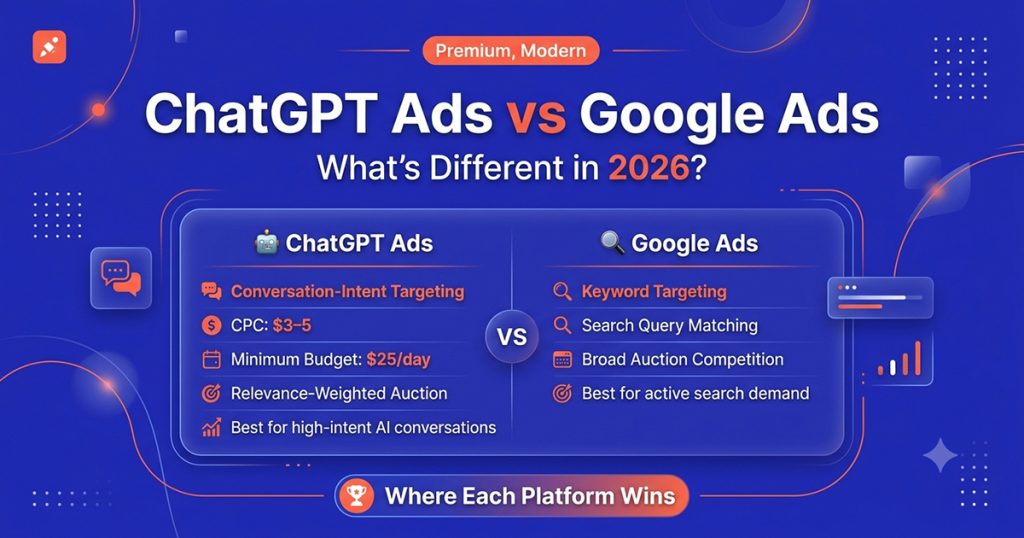
Google search ads target buyers through keyword-based queries — for example, someone types “CRM software pricing” because they already know what they need. ChatGPT ads, in contrast, appear inside conversational research sessions — someone asks “what’s the best CRM for a 20-person sales team that integrates with Salesforce?” because they’re still deciding.
Both channels reach high-intent buyers. However, neither replaces the other. And as a result, treating them as interchangeable is the fastest way to waste budget on both.
This guide compares ChatGPT ads vs Google ads across every dimension that determines where your next dollar should go: targeting, cost by industry, auction mechanics, buyer mindset, ad formats, audience reach, click-through rates, tracking infrastructure, and which businesses should prioritize which platform.
Quick Verdict
Google Ads wins for capturing buyers who already know what they want and are ready to act. The targeting is more mature, the volume is higher, and consequently the ROI is more predictable in established categories.
ChatGPT Ads win for reaching buyers who are still researching, comparing, and forming a view. Costs run significantly lower right now because few advertisers have entered the market yet.
The best strategy for most ecommerce brands is running both: ChatGPT to reach buyers early and shape the consideration set, then Google to close them when they’re ready. In other words, the brands visible on both sides of the journey close more revenue than brands that only show up at the bottom of the funnel.
ChatGPT Ads vs Google Ads at a Glance
| Feature | ChatGPT Ads | Google Search Ads |
|---|---|---|
| Platform launch | Feb 2026 pilot; self-serve May 2026 | 2000 (25+ years of history) |
| Targeting basis | Conversational context | Explicit keywords |
| Buyer stage | Research and discovery | High-intent, near-purchase |
| Auction type | Relevance-weighted, second-price | Quality Score–weighted |
| CPC (typical) | $3–$5 | $2–$50+ (category dependent) |
| CPM (typical) | $25–$60 | Varies widely |
| Minimum spend | None officially; ~$25+/day for delivery | No official minimum |
| Ad format | Text card below AI response | Text, Shopping, Display, Video, PMax |
| Competition level (2026) | Very low — early-mover window | Saturated in most categories |
| Retargeting | Not yet (roadmap item) | Yes, across Search and Display |
| Remarketing audiences | Not available | Extensive |
| Behavioural data | None — purely contextual | Extensive (Google’s first-party data) |
| Reachable audience | 900M+ weekly users (Free/Go tier only) | 8B+ searches per day |
| Privacy model | Contextual only, no user data shared | Dependent on consent and cookies |
| Conversion tracking | Pixel + Conversions API (new) | Mature, full attribution modelling |
What the table tells you
The comparison shows a clear structural story. Google has 25 years of infrastructure, tooling, and advertiser competition baked in. ChatGPT, on the other hand, has a thin auction, a contextual-only privacy model, and CPCs that haven’t felt the pressure of a crowded market yet. Both of those realities will change — the question is simply which direction each one moves.
How Buyer Intent Differs Between the Two Platforms
Google captures intent that has already formed. ChatGPT captures intent that is still forming. That single distinction, therefore, changes everything about what your ad should say, what your offer should be, and what you should measure as success.
Google: the buyer knows what they want
A user typing “buy CRM software” or “best running shoes under $150” into Google has already narrowed their decision. They know the category, they’ve probably shortlisted options, and they’re one click from converting. As a result, Google Search Ads intercept people at that near-purchase moment — the most valuable real estate in digital advertising.
ChatGPT: the buyer is still deciding
A user asking “what should I look for in a CRM for a small sales team?” or “how do I pick trail running shoes for flat feet?” is, by contrast, in discovery mode. They’re building their mental model of the category before they decide what to search for, who to contact, or what to buy. Consequently, ChatGPT Ads reach buyers at that earlier, open stage.
The decision-gap: why you need both sides
There’s a structural gap between where buyers research and where they convert. Specifically, a buyer asks ChatGPT for the best options, forms a shortlist, then opens a new tab and searches Google for the brand by name to buy.
Brands that only run Google ads therefore catch the second click but never enter the consideration set in the first place. Similarly, brands that only run ChatGPT ads get into the consideration set but lose the conversion to whoever owns the branded search result.
The full-funnel play is to show up on both sides of the gap — ChatGPT shapes which brands the buyer considers, and then Google captures the purchase when they’re ready to act.
Buyer Mindset: The Factor Most Advertisers Underestimate
The same person uses Google and ChatGPT in a fundamentally different mental state. Because of this, what works as an ad on one platform fails on the other.
Google: outcome-focused
The user has a goal and moves toward it. A direct, action-oriented ad matches that mindset. “Get a quote.” “Start your free trial.” “Buy now — free shipping.” These CTAs work precisely because the user is ready.
ChatGPT: exploration-focused
The user, however, learns, compares, and builds understanding. A hard-sell CTA interrupts that mode rather than fitting it. Instead, what works is an ad that adds value — “Here’s what to look for when choosing a growth agency” or “See how businesses like yours approach this decision.” The offer leads with usefulness first, and the conversion follows naturally.
The creative implication
If you run Google-style ads on ChatGPT without adapting them to the conversational context, your click-through rates will suffer. More specifically, the relevance-weighted auction actively penalizes generic, hard-sell copy. ChatGPT rewards specific, intent-matched messaging far more than brand slogans, because the matching happens at the conversation level rather than the keyword level.
Ad Formats: What Your Ads Actually Look Like
Google’s format library: broad and mature
Google offers the widest range of ad formats in digital advertising. Search ads appear as text links at the top of results pages. In addition, Shopping ads show product images, prices, and reviews with a direct click-to-buy. Beyond that, Display ads run across millions of websites, YouTube pre-roll and mid-roll reach video viewers, and Performance Max campaigns run across all Google surfaces simultaneously. As a result, the format depth gives experienced advertisers extensive creative and placement flexibility.
ChatGPT’s format: focused and text-driven
ChatGPT Ads, in contrast, appear as a single, clearly labelled sponsored card below the AI’s organic response. The format includes the advertiser’s name, favicon, headline, brief descriptive copy, an optional image, and a landing page link.
OpenAI calls this “answer independence” — meaning the ad system runs on infrastructure physically separate from the model generating responses, so advertising dollars cannot influence what ChatGPT actually says. The trade-off for that independence, however, is reach: ads only serve to logged-in adult users on the Free and Go tiers in the US, Canada, Australia, and New Zealand. Plus, Pro, Business, Enterprise, and Education subscribers see no ads.
Why text-only can work in your favour
The text-driven format actually works in your favour if your copy is strong. Without visual competition from a dozen other ads on the same page, a well-written ad that directly addresses what the user just asked about stands out. In other words, the quality of the writing matters more here than on any visual-heavy platform.
Cost Comparison: What You Actually Pay, by Industry
The cost gap between ChatGPT Ads and Google Ads is substantial right now. It will not, however, stay this way.
| Category | ChatGPT Ads CPC | Google Search CPC | Difference |
|---|---|---|---|
| B2B software / SaaS | $3–$5 | $15–$50 | ChatGPT 3× to 10× cheaper |
| Professional services | $3–$5 | $10–$35 | ChatGPT 2× to 7× cheaper |
| Legal and financial | $3–$5 | $20–$100+ | ChatGPT up to 20× cheaper |
| Ecommerce / retail | $3–$5 | $1–$5 | Similar; Google slightly cheaper |
| Healthcare | $3–$5 | $5–$25 | ChatGPT 1× to 5× cheaper |
The cost advantage hits hardest in B2B and high-value service categories where Google has become extremely competitive over two decades. For ecommerce with lower commercial-intent CPCs, on the other hand, the price gap narrows — although the thin auction still offers a first-mover edge that ecommerce brands rarely see on a new channel.
What changed in 2026 that most comparisons miss
Several important shifts happened in quick succession. First, CPC bidding for ChatGPT ads went live April 21, 2026, then rolled broadly with the self-serve Ads Manager on May 5. Second, the $50,000 pilot minimum is gone — any approved advertiser now sets a budget that fits their test. Third, the Measurement Pixel and Conversions API launched, closing most of the measurement gap that defined the early pilot.
That combination matters because the “ChatGPT is premium-only, Google is flexible” framing was true in February 2026 and false by May. As a result, SMBs, startups, and in-house teams now buy ChatGPT ads at the same budget level they’d test a new Google campaign.
Click-Through Rate: The Honest Caveat
CTR is where the two platforms still diverge most sharply, and it’s important to understand why.
| Metric | ChatGPT Ads | Google Search Ads |
|---|---|---|
| Average CTR | ~0.68% | 4–6% |
| Top quartile | ~1.0% | ~6–7% |
| Best-in-class | ~1.57% | ~7.94% |
Why the gap doesn’t mean what you think
Those numbers reflect fundamentally different placements, not platform quality. A Google Search ad appears at the top of a results page from a user who typed a buying query — so the click is the natural next step. A ChatGPT ad, by contrast, appears below an AI response that often already answered the question — meaning the user has less structural reason to click away.
ChatGPT’s lower CTR, therefore, doesn’t necessarily mean lower value. The platform’s strength sits in influence and consideration — the user may not click today but instead searches your brand name on Google tomorrow. Consequently, measuring ChatGPT Ads purely on last-click CTR undervalues their actual role in the funnel.
How Each Auction Actually Works
Understanding the auction mechanics explains why the same budget produces very different results on each platform.
Google’s auction: Quality Score rules
Google weighs your bid against Quality Score — a composite of expected click-through rate, ad relevance, and landing page experience. It’s mature, well-documented, and heavily gamed by a decade of SEM best practices. Essentially, win the Quality Score game and you pay less per click; lose it and you outspend competitors for worse placements.
OpenAI’s auction: relevance wins over spend
OpenAI, in contrast, runs a relevance-weighted, second-price model. The ad that wins the placement isn’t automatically the highest bidder — instead, it’s the ad with the best combined score of bid and contextual relevance to the conversation.
For example, a well-written, tightly relevant ad on a $3.50 bid regularly outperforms a generic ad sitting on a $6 bid. This represents a meaningful departure from “outspend the competition” logic, and as a result it levels the playing field for smaller brands that can’t outbid category leaders on Google.
The privacy trade-off
One structural limitation is also worth knowing: OpenAI does not share the raw content of a user’s prompt with advertisers, for privacy reasons. You know your ad matched contextually — but you don’t see the exact conversation that triggered it. Because of this, accurate post-click measurement becomes more important on ChatGPT Ads than on Google, not less. If you can’t see the pre-click intent, your conversion tracking accuracy carries the entire weight of optimization.
Audience Size: Who You Can Actually Reach
Google’s scale
Google processes over 8 billion searches per day. The volume of available impressions is therefore enormous, and for established commercial categories, Google delivers meaningful traffic at almost any budget level. That scale and reliability is precisely why Google remains the dominant paid channel for most performance advertisers.
ChatGPT’s reachable audience
ChatGPT has over 900 million weekly active users — however, ads only appear to Free and Go tier subscribers. Plus, Pro, Team, Business, Enterprise, and Education plan users see no ads.
The implication worth noting: the ad-exposed audience skews toward consumer and SMB users, while enterprise decision-makers who pay for subscriptions aren’t reachable through ChatGPT Ads. Whether that’s a limitation depends entirely on who you sell to. For Shopify ecommerce brands, specifically, the free-tier audience — tech-savvy, research-oriented, comparison-driven — often maps well to the ideal buyer profile.
Which Industries Benefit Most from Each Platform
Industry fit ultimately shifts the math on which platform deserves the larger budget share. Some verticals convert almost entirely through high-intent search; others, by contrast, spend weeks in research before any direct query happens.
Industries where ChatGPT Ads outperform on cost and fit
- B2B SaaS and enterprise software — long evaluation cycles, high Google CPCs, research-heavy buyers
- Professional services and consulting — buyers compare extensively before they hire
- Legal and financial services — Google CPCs exceed $20–$100+; ChatGPT reaches the same buyer at $3–$5
- High-consideration DTC — supplements, electronics, premium apparel where the buyer researches before committing
- Education and online courses — learners ask ChatGPT for recommendations naturally
Industries where Google Ads remain the stronger channel
- Ecommerce with clear product-keyword demand — “buy Nike Air Max 90” is a Google query, not a ChatGPT question
- Local services — HVAC, plumbing, roofing, electricians; “plumber near me” is pure search intent
- Emergency and urgent services — the buyer needs someone now, not a comparison
- Travel with date-specific intent — “flights to London June 15” converts on Google, not in a chat
The pattern
In short, ChatGPT wins where the buyer’s first question is “which option should I consider.” Google wins where the buyer’s first question is “who can I hire right now.” Brands selling into both moments, therefore, need budget on both platforms.
Tracking: Where the Platforms Diverge on Infrastructure
Whichever platform you test, the ad only performs as well as the data it learns from — and this is where the two channels diverge again, this time on infrastructure rather than targeting.
Google’s Shopify integration: mature and native
Google has had years to build its Shopify integration. The Google & YouTube channel app handles pixel installation, catalog sync, and conversion tracking out of the box. As a result, the infrastructure is battle-tested.
OpenAI’s Shopify integration: newer, and the gap matters
Shopify, however, doesn’t yet ship a native integration for OpenAI Ads. That gap is exactly what dedicated tracking apps exist to close — and the mechanism that matters most is server-side event delivery.
A browser-based pixel loses roughly a third of your conversions to ad blockers, iOS privacy protections, and Shopify’s checkout redirects. On Google, where the algorithm draws on years of data and multiple signal sources, that loss hurts but doesn’t cripple. On ChatGPT Ads, by contrast, where the algorithm starts from zero and depends entirely on the signal you feed it, a 35% data gap teaches the model to chase the wrong buyers from day one.
How server-side tracking closes the gap
Count handles this on Shopify in one click — server-side event delivery for page views, add-to-carts, and purchases sent directly from Shopify’s backend rather than a browser script. The verified match rate against actual Shopify orders sits at 99.4%, versus roughly 64% with browser-only pixels. Deduplication by Shopify order ID ensures each sale counts exactly once, and real-time delivery gets events into your OpenAI Ads dashboard in under 60 seconds. No theme edits, no code, no developer needed. The free plan includes the full server-side pixel.
The practical takeaway: if you test ChatGPT Ads on Shopify, don’t port over your Google tracking assumptions. Instead, confirm you have a server-side connection in place before you spend a dollar — otherwise the relevance-weighted auction optimizes on a fraction of your real sales, and you’ll never know whether the channel actually worked or your data just didn’t show it.
When to Choose Google Ads, ChatGPT Ads, or Both
Prioritize Google Ads if you:
- Sell products with clear keyword demand and transactional search volume
- Run direct-response or ecommerce campaigns that need measurable same-session conversions
- Need granular geo, device, or audience targeting along with remarketing
- Operate in a local service category where “near me” searches drive the business
Prioritize ChatGPT Ads if you:
- Sell products buyers research and compare before committing
- Target shoppers who use AI tools during their decision process
- Want to establish brand visibility before competitors discover the channel
- Face high Google CPCs in your vertical and need lower-cost research-stage reach
- Have strong copy — because the relevance-weighted auction rewards writing over budget
Run both if you:
- Sell anything where the buyer researches before purchasing (which includes most ecommerce and B2B)
- Want to shape the consideration set and also capture the conversion
- Can measure across the funnel rather than relying on last-click attribution alone
How to Allocate Budget Between the Two Platforms
If you already run Google Ads and want to add ChatGPT
Don’t reduce your Google budget to fund the test — Google is proven for your store, so instead run the ChatGPT test as incremental spend. Start with a 60-day test at $25–$50/day (roughly $1,000–$1,500 total), then adapt your creative for the research mindset and measure cost per acquisition alongside click-through rate. If you simply port Google copy unchanged, your ChatGPT CTR will underperform and consequently the test tells you nothing useful.
If you’re starting from zero
Start with the channel most proven for your specific category. For most Shopify ecommerce stores, that means Google Shopping and Search first. Build a performance baseline, and then add ChatGPT Ads as your second channel once you have conversion data to compare against.
If ChatGPT is already working
Scale carefully. Increase daily budget in 20–30% increments rather than doubling overnight — because the thin auction can shift delivery patterns unpredictably at sudden budget jumps. Also make sure your conversion tracking captures every sale before you scale, since scaling on incomplete data only compounds the error.
Rather have someone handle the whole setup?
The team behind Count also sets up, launches, and manages OpenAI Ads campaigns on the same server-side foundation. The managed service starts with a free readiness audit that measures your actual conversion gap before you commit a dollar of ad spend.
The Bottom Line
Google captures demand that already exists. ChatGPT Ads, on the other hand, reach shoppers in the moment they’re actively deciding — a genuinely new slot in the funnel, not a replacement for search. The auction rewards relevance over budget, the competition is still thin, and the CPCs undercut Google in most verticals.
The channel that’s easiest to get wrong right now is the newest one, simply because the tracking infrastructure isn’t as battle-tested as Google’s native Shopify integration. Fix the measurement gap first with server-side tracking, and then the comparison stops being theoretical.
Ultimately, testing both platforms isn’t an either/or decision. It’s a question of which part of the buyer’s journey you’re under-investing in — and in 2026, the research-stage slot that ChatGPT owns is the one with the most room to grow.
Frequently Asked Questions
Q1: Are ChatGPT ads cheaper than Google ads?
In most categories, yes — ChatGPT’s $3–$5 CPC range sits below Google’s, which stretches from a couple of dollars to well over $50 in competitive verticals like legal and B2B SaaS. The gap runs widest in high-CPC industries: for instance, a legal brand paying $40+ per Google click can test ChatGPT at $3–$5 and reach users at a similar research stage. However, cost per click isn’t the full picture — Google’s captured search intent can convert at a higher rate for bottom-funnel queries, which sometimes offsets the higher CPC. Therefore, compare cost per acquisition, not just cost per click.
Q2: Does ChatGPT Ads use keyword targeting like Google?
No. OpenAI’s system matches ads to the context of an ongoing conversation rather than specific keywords. Instead, advertisers write descriptions of the topics and intent signals their ads should match, and the platform’s inference engine handles the placement. Additionally, OpenAI doesn’t share raw prompt text with advertisers for privacy reasons — so you target conversational themes, not individual search terms.
Q3: Can I retarget ChatGPT Ads visitors like I can with Google?
Not yet. Retargeting, saved audiences, and remarketing functionality sit on OpenAI’s public roadmap but weren’t available on the self-serve platform as of mid-2026. As a result, ChatGPT Ads currently function as a prospecting and consideration channel, not a remarketing one.
Q4: What’s the click-through rate on ChatGPT Ads compared to Google?
ChatGPT ads currently average around 0.68% CTR overall, with top-performing advertisers reaching roughly 1.0–1.57%. Google Search ads, by comparison, average 4–6%, with top-position ads closer to 7.94%. However, the difference reflects placement mechanics rather than platform quality — ChatGPT’s ad appears below a response that often already answered the question, so users have less structural reason to click. Consequently, measuring ChatGPT purely on last-click CTR undervalues its actual role in shaping the consideration set.
Q5: Who actually sees ChatGPT ads?
Ads serve to logged-in adult users on the Free and Go subscription tiers in the US, Canada, Australia, and New Zealand. Users on Plus, Pro, Team, Business, Enterprise, and Education plans, in contrast, see no ads. As a result, the reachable audience skews toward consumer and SMB users — while enterprise decision-makers who pay for subscriptions sit outside the addressable pool.
Q6: How do I track ChatGPT Ads conversions on Shopify?
Through a server-side connection between your Shopify store and OpenAI’s Conversions API. A browser-only pixel misses roughly a third of sales due to ad blockers and iOS privacy features, which cripples optimization on a new channel where the algorithm starts from zero. An app like Count installs server-side tracking in one click and verifies match rates against your real Shopify order data.
Q7: Should I move budget from Google to ChatGPT Ads?
Not as a replacement — instead, as an addition. Google owns bottom-funnel “buy now” intent that ChatGPT doesn’t compete for. ChatGPT, meanwhile, owns the research-and-comparison stage that Google reaches only through broader, more expensive campaigns. Therefore, run the ChatGPT test as incremental spend alongside your existing Google budget, not at its expense.
Q8: What’s the minimum budget to test ChatGPT Ads?
No platform-wide minimum spend exists as of the May 2026 self-serve launch. In practice, however, daily budgets under roughly $25 rarely deliver consistently. Most practitioners recommend $25–$50/day over a 60-day test window — roughly $1,000–$1,500 total — to gather enough conversion data for real optimization decisions.