A Shopify brand spending $10,000 a month on Meta Ads eventually asks whether ChatGPT Ads deserve a slice of that budget. The platforms look different — one is a social feed, the other is a conversation — but the real question is whether they reach different buyers at different moments, or just the same people in a different wrapper.
The answer matters more than it sounds, because ChatGPT ads vs Meta ads isn’t a “which is better” decision. It’s a “which moment in the buyer’s journey am I missing” decision. Each platform owns a distinct slot, and understanding where those slots sit determines whether adding ChatGPT Ads grows your revenue or just spreads your budget thinner.
This guide compares the two platforms across targeting, cost, buyer mindset, ad formats, audience size, and tracking infrastructure — so you can decide where the next dollar goes.
Quick Verdict
Meta Ads win for cold-audience discovery, visual storytelling, and retargeting at scale. The targeting stack is the most mature in social advertising, the creative formats are the richest, and the platform still generates volume that nothing else matches.
ChatGPT Ads win for reaching buyers during active research — the comparison, evaluation, and “help me choose” moments that happen before the buyer ever opens Instagram. Costs run lower right now because few advertisers have entered the auction yet.
The best strategy for most Shopify brands is running both. Meta creates awareness and demand. ChatGPT captures the research moment that sits between awareness and purchase. Together, they cover more of the journey than either one alone.
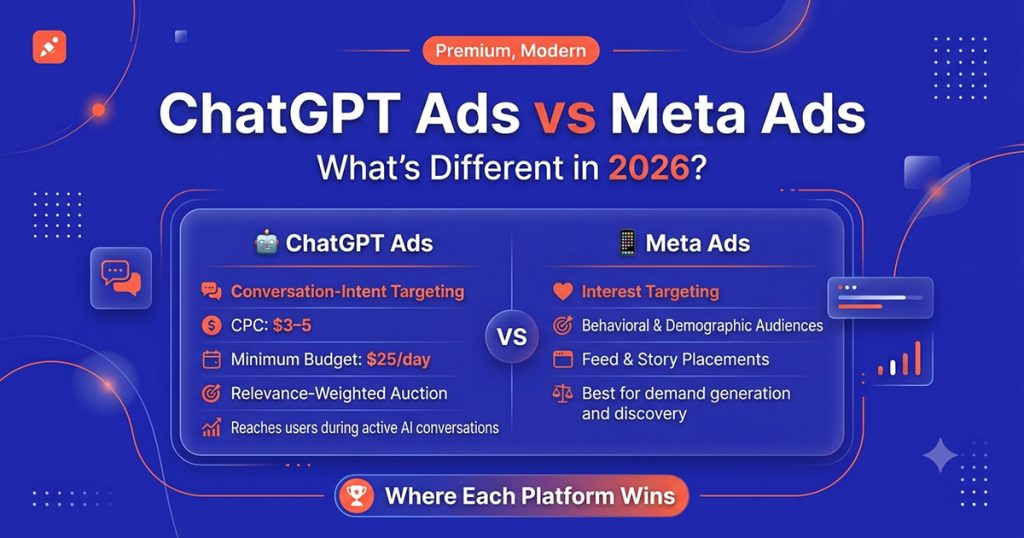
ChatGPT Ads vs Meta Ads at a Glance
| Feature | ChatGPT Ads | Meta Ads |
|---|---|---|
| Platform launch | Feb 2026 pilot; self-serve May 2026 | 2007 (19+ years of history) |
| Targeting basis | Conversational context | Interests, behaviour, demographics |
| Buyer stage | Mid-research, evaluating | Cold discovery, retargeting |
| Auction type | Relevance-weighted, second-price | Relevance/engagement-weighted |
| CPC (typical) | $3–$5 | $0.50–$3 |
| CPM (typical) | $25–$60 | $5–$15 |
| Minimum spend | None officially; ~$25+/day for delivery | No official minimum |
| Ad format | Text card below AI response | Image, video, carousel, stories, reels |
| Competition level (2026) | Very low — early-mover window | Saturated in most categories |
| Retargeting | Not yet (roadmap item) | Yes, deep and mature |
| Behavioural data | None — purely contextual | Extensive (Meta’s first-party data) |
| Reachable audience | 900M+ weekly users (Free/Go tier only) | 3B+ monthly active users |
| Privacy model | Contextual only, no user data shared | Behavioural, consent-dependent |
| Creative emphasis | Copy quality and specificity | Visual impact and scroll-stopping |
What the table reveals
The structural story is clear. Meta has nearly two decades of infrastructure, the largest addressable audience in digital advertising, and the cheapest CPCs of any major platform. ChatGPT, on the other hand, has a thin auction, a contextual-only targeting model, and a buyer who’s actively thinking rather than passively scrolling. Those are fundamentally different strengths, not competing ones.
How Buyer Intent Differs Between the ChatGPT Ads vs Meta Ads
Meta captures attention. ChatGPT captures deliberation. That single distinction changes everything about what your ad should say, what your offer should be, and what you should measure as success.
Meta: the buyer isn’t looking for you
Nobody opens Instagram because they need a new product. They’re watching reels, scrolling stories, checking what friends posted. Your ad interrupts that experience. As a result, Meta creative has to work harder to earn attention — it needs to stop the scroll, create desire, and convert someone who wasn’t thinking about buying anything thirty seconds ago. This is what Meta does brilliantly, and it’s why the platform dominates cold-audience discovery.
ChatGPT: the buyer is actively deciding
A user asking ChatGPT “what’s the best lightweight stroller for city commuting?” is mid-decision. They’re comparing options, weighing trade-offs, and building a shortlist. Your ad appears below a detailed AI response, in context, at the exact moment they’re forming a preference. The intent isn’t interruption-based — it’s research-based.
The discovery-to-decision gap
There’s a structural gap between where buyers first discover a product and where they evaluate their options. Meta dominates the discovery side — a shopper sees a striking product image while scrolling, clicks, and starts considering. ChatGPT, however, dominates the evaluation side — the same shopper later asks an AI assistant to compare options, reads the response, and narrows down.
Brands visible on both sides of the gap close more revenue. Brands visible on only one side either create demand without capturing it (Meta only) or try to capture demand they never helped create (ChatGPT only).
Buyer Mindset: Why the Same Ad Can’t Work on Both
The same person uses Meta and ChatGPT in fundamentally different mental states. Because of this, creative that wins on one platform typically fails on the other.
Meta: emotion-driven, visual, fast
The user scrolls quickly. Your ad has roughly one second to earn attention. Bold imagery, emotional hooks, aspirational lifestyle shots, and punchy headlines do the work. “Shop the look,” “limited drop,” and “see why 50,000 customers switched” are native to this environment. The mindset is discovery — show me something I didn’t know I wanted.
ChatGPT: logic-driven, text-heavy, deliberate
The user just read a 300-word AI response comparing options. They’re in analytical mode. Consequently, a hard-sell CTA or an urgency banner feels like a tonal mismatch — the equivalent of a car salesman interrupting a library. What works is copy that adds value: “here’s what to look for in a city stroller” or “compare weight, fold size, and basket capacity.” The mindset is evaluation — help me decide.
The creative implication
If you run Meta-style creative on ChatGPT without adapting it, your CTR will suffer. More importantly, the relevance-weighted auction actively penalizes generic, hard-sell copy. ChatGPT rewards specific, intent-matched messaging, which means the quality of your writing directly affects your CPC. On Meta, visuals drive results. On ChatGPT, therefore, copy drives results.
Ad Formats: What Your Ads Actually Look Like
Meta’s format library: visual and varied
Meta offers the broadest visual ad format range in social advertising. Single images in the feed, carousel ads showing multiple products, vertical video for stories and reels, collection ads with instant storefronts, and dynamic product ads that personalize based on browsing history. The format depth gives experienced advertisers extensive creative flexibility, and visual impact is the primary driver of performance.
ChatGPT’s format: text-first and focused
ChatGPT Ads, in contrast, appear as a single sponsored card below the AI’s organic response. The format includes a headline, brief description, optional image, and a landing page link. OpenAI calls this “answer independence” — the ad runs on infrastructure separate from the model, so advertising dollars cannot influence what ChatGPT actually says.
The trade-off for that independence is reach. Ads only serve to logged-in adult users on the Free and Go tiers in the US, Canada, Australia, and New Zealand. Plus, Pro, Business, and Enterprise subscribers see no ads at all.
Why text-only can be an advantage
The text-focused format works in your favour if your copy is strong. Without competing against bold visuals from other advertisers on the same page, a well-written ad that directly addresses the user’s question stands out. In other words, you win on specificity and relevance rather than on creative production value — which levels the playing field for smaller brands.
Cost Comparison: What You Actually Pay
Meta’s CPCs are cheaper. ChatGPT’s intent is higher. That trade-off defines the cost conversation, and understanding it prevents you from drawing the wrong conclusion from raw numbers.
| Category | ChatGPT Ads CPC | Meta Ads CPC | Context |
|---|---|---|---|
| B2B / SaaS | $3–$5 | $1.50–$4 | Similar CPC, but ChatGPT reaches mid-research buyers |
| Fashion / apparel | $3–$5 | $0.50–$2 | Meta cheaper; discovery-driven category favours visual |
| Electronics | $3–$5 | $1–$3 | ChatGPT captures comparison shoppers |
| Health / wellness | $3–$5 | $0.80–$2.50 | Meta wins on volume; ChatGPT wins on buyer stage |
| Home / garden | $3–$5 | $0.70–$2 | Research-heavy purchases favour ChatGPT |
Why cheaper CPC doesn’t mean better value
Meta’s CPCs are lower because the audience is colder. A $0.80 click from someone who was watching cat videos and happened to pause on your ad is fundamentally different from a $4 click from someone who just asked an AI assistant to compare your product against two competitors. The first needs nurturing, retargeting, and often multiple touchpoints before converting. The second, however, is already evaluating and may convert in one session.
Compare cost per acquisition, not cost per click. In many categories, ChatGPT’s higher CPC produces a comparable or lower CPA because the buyer arrives further down the funnel.
What changed in 2026
Several shifts happened in quick succession. First, ChatGPT CPC bidding went live in April 2026 and rolled broadly with the self-serve Ads Manager in May. Second, the $50,000 pilot minimum disappeared — any approved advertiser now sets a budget that fits their test. As a result, SMBs and in-house teams can now test ChatGPT ads at the same budget level they’d use for a new Meta campaign.
Click-Through Rate: Different Formats, Different Expectations
CTR is where the two platforms diverge most visually, and it’s important to understand why the gap doesn’t mean what it looks like.
| Metric | ChatGPT Ads | Meta Ads |
|---|---|---|
| Average CTR | ~0.68% | 0.9%–1.5% (feed); 1.5%–2.5% (stories) |
| Top quartile | ~1.0% | 2%–3% |
Why the comparison is misleading
Meta ads appear in a scroll-based environment designed to generate clicks. The entire UX guides users toward tapping content. ChatGPT ads, by contrast, appear below an AI response that often already answered the question. The user has less structural reason to click away because they already received value.
ChatGPT’s lower CTR doesn’t therefore mean lower impact. The platform’s real strength sits in influence — the user may not click today, but searches your brand name elsewhere tomorrow. Measuring ChatGPT purely on last-click CTR consequently undervalues its role in shaping the consideration set.
Audience Size: Who You Can Actually Reach
Meta’s scale
Meta’s family of apps — Facebook, Instagram, WhatsApp, Messenger — reaches over 3 billion monthly active users globally. For Shopify brands, the addressable audience on Facebook and Instagram alone dwarfs every other advertising platform. That scale, combined with deep behavioural targeting, is why Meta remains the dominant paid social channel.
ChatGPT’s reachable audience
ChatGPT has over 900 million weekly active users. However, ads only appear to Free and Go tier subscribers. Plus, Pro, Team, Business, and Enterprise users see no ads. The practical audience is therefore smaller than the headline number suggests.
For Shopify ecommerce brands, though, the free-tier audience often maps well to the ideal buyer — tech-savvy, research-driven, and comparison-oriented. Whether the smaller addressable audience matters depends on your category. If your product appeals to digitally native consumers who use AI tools during their buying process, the fit is strong despite the narrower reach.
Tracking: Where the Platforms Diverge on Infrastructure
Both platforms need accurate conversion data. However, the consequences of bad tracking differ dramatically between the two.
Meta’s Shopify integration: mature but not immune
Meta has years of Shopify integration through the Facebook & Instagram channel app. However, Meta also suffered heavily from iOS 14.5 privacy changes, and browser-only tracking still misses a meaningful share of conversions. Most sophisticated Meta advertisers already run the Conversions API for server-side delivery. If you’re not doing this on Meta yet, you should be.
ChatGPT’s tracking gap: newer and more damaging
Shopify doesn’t ship a native integration for OpenAI Ads. That gap is exactly what dedicated tracking apps exist to close. On Meta, the algorithm has years of data and can partially compensate for tracking gaps. On ChatGPT, where the algorithm starts from zero, a 35% data gap teaches the model to chase the wrong buyers from its very first impression.
Server-side tracking through Count closes this gap in one click — 99.4% match rate against Shopify orders, automatic deduplication by order ID, and real-time event delivery in under 60 seconds. The free plan includes the full server-side pixel.
The practical takeaway: if you’re adding ChatGPT Ads to your Meta spend, don’t assume the same tracking setup covers both. Confirm server-side delivery for the new channel specifically before you spend a dollar on it.
Which Industries Benefit Most from Each Platform
Industry fit determines which platform deserves the larger budget share. Some categories sell through visual discovery. Others sell through deliberate research.
Categories where Meta Ads remain dominant
- Fashion, apparel, and accessories — discovery-driven, visual-first, impulse-friendly
- Beauty and personal care — before-and-after content, influencer integration, UGC
- Food and beverage DTC — lifestyle imagery, subscription-driven, low-consideration
- Home décor — aspirational, visually led, “I didn’t know I wanted this” buying behaviour
Categories where ChatGPT Ads outperform
- Electronics and gadgets — comparison-heavy, spec-driven, research-intensive
- Health supplements and wellness — buyers research ingredients and clinical claims before purchasing
- Premium / high-AOV products — considered purchases where the buyer evaluates before committing
- B2B SaaS and professional tools — long evaluation cycles, multiple stakeholders
The pattern
Meta wins where the buyer’s first reaction is “I want that.” ChatGPT wins where the buyer’s first reaction is “let me look into this.” Brands selling products that trigger both reactions need budget on both platforms.
When to Choose Meta Ads, ChatGPT Ads, or Both
Prioritize Meta Ads if you:
- Sell visually striking products that create desire on sight
- Need cold-audience discovery and top-of-funnel awareness at scale
- Rely heavily on retargeting to close sales
- Have strong video and image creative assets
- Operate in a low-consideration, impulse-friendly category
Prioritize ChatGPT Ads if you:
- Sell products buyers research and compare before committing
- Target shoppers who use AI tools during their decision process
- Want to reach buyers during the evaluation moment Meta can’t access
- Face rising Meta CPMs and need a research-stage channel at lower cost
- Have strong copy — because the relevance-weighted auction rewards writing over production value
Run both if you:
- Sell anything where the buyer discovers on social and then researches before buying
- Want to create demand and capture the consideration moment
- Can measure across the funnel rather than relying on last-click attribution alone
How to Allocate Budget Between the Two
If you already run Meta and want to add ChatGPT
Don’t cut your Meta budget. Meta is proven for your store — instead, run the ChatGPT test as incremental spend. Start with $25–$50/day for 60 days (roughly $1,000–$1,500 total). Adapt your creative for the research mindset, because porting Meta visuals and urgency copy unchanged will produce misleading results.
If you’re starting from zero
For most Shopify brands, Meta is still the stronger starting point. Build your audience, test creative, and establish a performance baseline on the platform with the deepest targeting and the richest format options. Then add ChatGPT Ads as your second channel once you have conversion data to compare against.
If ChatGPT is already working
Scale carefully by increasing daily budget in 20–30% increments. Make sure your conversion tracking captures every sale before you scale, since scaling on incomplete data compounds the error.
Rather have someone handle the whole setup?
The team behind Count sets up, launches, and manages OpenAI Ads campaigns on the same server-side tracking foundation. Count’s managed service starts with a free readiness audit — so you see your actual conversion gap before you commit a dollar.
The Bottom Line
Meta creates demand. ChatGPT captures the research moment that decides which brand wins the sale. The two platforms don’t compete for the same buyer at the same moment — they own different stages of the same journey.
The brands that show up on both sides of the discovery-to-decision gap will outperform the brands that only invest in one side. Meta’s scale and visual power aren’t going anywhere. ChatGPT’s conversational slot is new, the auction is thin, and the CPCs haven’t felt competitive pressure yet.
Testing both isn’t about replacing Meta. It’s about covering the moment Meta can’t reach — and in 2026, that research-stage moment is the one with the most room to grow.
Frequently Asked Questions
Q1: Are ChatGPT ads more expensive than Meta ads?
On a cost-per-click basis, yes — ChatGPT’s $3–$5 CPC sits above Meta’s typical $0.50–$3 range. However, ChatGPT’s clicks come from buyers who are actively researching and comparing, while Meta’s clicks come from a colder audience that needs more touchpoints to convert. As a result, cost per acquisition is often comparable between the two, because ChatGPT’s higher-intent clicks convert at a higher rate.
Q2: Can I use my Meta ad creative on ChatGPT Ads?
It’s not recommended. Meta creative relies on bold visuals, emotional hooks, and scroll-stopping imagery — none of which translates to a text-based card below an AI response. ChatGPT rewards specific, helpful copy that matches the conversational context. Reusing Meta creative unchanged will produce low CTR and consequently higher CPCs.
Q3: Does ChatGPT Ads have retargeting like Meta?
Not yet. Retargeting and saved audience functionality sit on OpenAI’s public roadmap but weren’t available on the self-serve platform as of mid-2026. For now, ChatGPT Ads function as a prospecting and consideration channel, while Meta remains the stronger platform for remarketing.
Q4: Who actually sees ChatGPT ads?
Ads serve to logged-in adult users on the Free and Go subscription tiers in the US, Canada, Australia, and New Zealand. Users on Plus, Pro, Team, Business, and Enterprise plans see no ads. The reachable audience therefore skews toward consumer and SMB users rather than enterprise subscribers.
Q5: Should I move budget from Meta to ChatGPT Ads?
Not as a replacement — instead, as an addition. Meta owns cold-audience discovery and retargeting, which ChatGPT doesn’t compete for. ChatGPT owns the research-and-evaluation stage that Meta can’t access because users aren’t in research mode while scrolling Instagram. Run the ChatGPT test as incremental spend alongside your existing Meta budget.
Q6: How do I track ChatGPT Ads conversions on Shopify?
Through a server-side connection to OpenAI’s Conversions API. Browser-only pixels miss roughly a third of sales to ad blockers and iOS privacy features. An app like Count installs server-side tracking in one click and verifies match rates against actual Shopify order data — the free plan covers the full pixel.
Q7: Which platform should a new Shopify brand start with?
For most new brands, Meta first. It offers the deepest targeting, the richest creative formats, and the largest addressable audience. Build your performance baseline there, then add ChatGPT Ads as your second channel once you have conversion data to compare against and enough budget to run both without spreading either too thin.
Q8: What’s the minimum budget to test ChatGPT Ads alongside Meta?
No platform minimum exists. In practice, $25–$50 per day over a 60-day test window — roughly $1,000–$1,500 total — generates enough data for real optimization decisions. Run this as incremental spend, not by reducing your Meta budget, so you can measure the added value without disrupting what’s already working.