The question comes up the moment any Shopify brand considers ChatGPT Ads: should we hire an openai ads agency, or can we run this ourselves?
On most ad platforms, the answer depends on budget and internal bandwidth. OpenAI Ads, however, adds a wrinkle that makes the decision genuinely different. The channel is new, the tracking infrastructure isn’t native to Shopify, the creative format rewards a different skill set than Meta or Google, and the auction mechanics are still unfamiliar to most performance marketers. Some of those challenges are temporary. Others are structural.
This guide compares three paths — full DIY, a one-time setup sprint, and ongoing managed service — so you can pick the one that fits your team, your budget, and your tolerance for learning curves without overpaying for help you don’t need.
Why This Decision Is Harder on OpenAI Ads
On Meta and Google, the “do it yourself or hire someone” question is well-trodden. Thousands of tutorials, courses, and community forums exist. The Shopify integrations are native. The auction mechanics are documented to death. A competent marketer can get campaigns live in an afternoon.
OpenAI Ads, by contrast, stacks several unfamiliar layers on top of each other.
The tracking gap isn’t optional
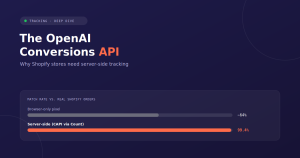
Shopify doesn’t ship a native OpenAI Ads integration. As a result, you need to install a server-side pixel, connect the Conversions API, and verify event deduplication before your first campaign can optimize properly. A browser-only pixel misses roughly a third of your sales, which means the algorithm learns from biased data and targets the wrong buyers from day one. On Meta or Google, tracking errors hurt performance. On OpenAI Ads, they can kill the channel entirely before you’ve gathered enough data to evaluate it.
The creative rules are different
ChatGPT ads appear below a detailed AI response inside a conversation. Sales-heavy, urgency-driven copy that performs on Meta tanks your relevance score here, which consequently raises your CPC. Writing for this format requires a different instinct — more content marketing, less direct response.
The auction is thin and unfamiliar
OpenAI runs a relevance-weighted, second-price auction that rewards contextual fit over bid size. Most PPC managers have never optimized for this model, because Google and Meta both weight their auctions differently. The learning curve is real, and learning costs money.
So the question becomes specific
The real decision isn’t “agency or no agency.” It’s “which of these three layers do I need help with, and for how long?”
Path 1: Full DIY — Run Everything Yourself
When this makes sense
DIY works best when your team has a specific combination of strengths. First, someone on the team understands server-side tracking well enough to install and verify a Conversions API connection. Second, your creative team already writes content-marketing-style copy rather than direct-response ads. Third, you have the patience to run a 60-day test at $25–$50/day without pulling the plug after week one.
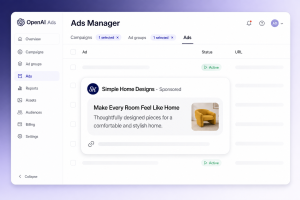
If all three conditions are true, you can launch OpenAI Ads without outside help. The platform’s self-serve Ads Manager is straightforward once the tracking foundation is solid.
Where DIY typically breaks
The most common failure point isn’t the campaign — it’s the tracking. A merchant installs a browser pixel, launches campaigns, sees mediocre results, and concludes the channel doesn’t work. In reality, the pixel missed 35% of the sales, and the algorithm optimized on the wrong audience the entire time. The merchant never discovers the problem because nothing in the dashboard flags it.
The second failure point is creative. Teams that recycle Google or Meta copy see low click-through rates, which raises CPCs in the relevance-weighted auction, which makes the channel look unprofitable. The copy isn’t bad — it’s just built for a different medium.
The honest cost
Your time. Budget $1,000–$1,500 in ad spend for a meaningful 60-day test, plus the internal hours to set up tracking, write conversational copy, monitor the event log weekly, and iterate. If your hourly loaded cost is $75 and you spend 20 hours across two months, the real cost is $1,500 in time plus the ad spend.
Path 2: Setup Sprint — Get Help With the Foundation, Then Run It Yourself
When this makes sense
A setup sprint fits brands that have the internal skill to manage campaigns day-to-day but don’t want to gamble the tracking setup. This is the most common situation, because the tracking layer is where most DIY attempts fail, and consequently it’s where outside help delivers the highest return.
In this model, a specialist handles the one-time setup: server-side pixel installation, Conversions API connection, event deduplication verification, test-order validation, and robots.txt configuration. Once the foundation is verified, your team takes over campaign management, creative, and optimization.
Where a sprint typically breaks
The handoff. If your team doesn’t understand how to read the event log, audit platform-versus-Shopify conversion counts weekly, or write for the conversational format, the solid foundation erodes within weeks. A sprint works only if the internal team commits to learning the channel after the setup is done.
The honest cost
The setup itself is often free or low-cost — for instance, installing a server-side tracking app takes under two minutes and costs nothing on the free tier. The “sprint” cost is really the time your team invests in learning a new platform, which is lower than full DIY because the riskiest step (tracking) is already handled.
Path 3: Fully Managed — Hand Off the Entire Channel
When this makes sense
Full management fits brands in one of three situations. First, the team is already stretched across Meta, Google, email, and SEO, and adding another channel means something else gets neglected. Second, the brand operates in a high-CPC vertical (legal, financial, B2B SaaS) where the cost difference between ChatGPT and Google is large enough to justify agency fees. Third, the team simply doesn’t have anyone who writes content-marketing-style copy, and hiring for that skill set costs more than outsourcing the channel.
What “managed” should actually include
Not every openai ads agency delivers the same scope. Before you sign anything, confirm the service covers all three layers — not just campaign management.
Tracking layer: Server-side pixel installation, Conversions API connection, deduplication, real-time event monitoring, and ongoing validation. If the agency doesn’t handle this, you’re paying for campaign management built on data that might be 35% wrong.
Creative layer: Ad copy written specifically for the conversational format, tested in three-to-five variations, refreshed every two to three weeks. If the agency recycles your Meta or Google copy, your relevance scores will suffer and consequently your CPCs will rise.
Campaign layer: Bid management, budget allocation, geo-targeting configuration, and weekly performance reporting against Shopify actuals — not just platform metrics.
Red flags when evaluating an agency
Watch for these signals that an openai ads agency doesn’t actually understand the platform:
- They propose keyword targeting. OpenAI Ads doesn’t use keywords — it matches ads to conversational context.
- They skip the tracking conversation. If the agency doesn’t ask about your pixel setup in the first call, they plan to run campaigns on whatever data happens to arrive, which is how you burn budget on a 64% signal.
- They guarantee specific ROAS numbers. The channel is new, benchmarks are thin, and anyone guaranteeing outcomes on a six-month-old platform is selling confidence rather than competence.
- They charge setup fees but use a browser-only pixel. Server-side tracking is the baseline, not the premium.
The honest cost
Agency fees for chatgpt ads management typically range from a flat monthly retainer to a percentage of ad spend, depending on scope. The right question isn’t “how much does the agency cost” — it’s “does the agency cost less than the revenue I’d lose by running incomplete tracking and mismatched creative for three months while I figure it out?”
How to Decide: The Three-Question Framework
You don’t need a quiz or a consultation to answer this. Three questions sort you into the right path.
Question 1: Can you install and verify server-side tracking?
If yes, you’ve cleared the hardest technical hurdle. Move to question two. If no, you need at minimum a setup sprint — and the good news is that a one-click tracking app like Count handles this in under two minutes on the free plan, so “no” doesn’t automatically mean “hire an agency.”
Question 2: Can you write content-marketing-style copy?
If your team already produces blog posts, guides, or educational content, the creative skills transfer. If your team’s strength is visual creative and direct-response — Meta-style hooks, urgency CTAs, bold imagery — then the conversational format requires either retraining or outsourcing.
Question 3: Does your team have bandwidth for a new channel?
If adding OpenAI Ads means your best performer splits attention from a channel that’s already working, the math favors handing the new channel to someone else. A new platform during its learning phase demands consistent attention. Sporadic management produces sporadic results.
All three yes → DIY. Two yes, one no → sprint or partial help. One or zero yes → fully managed makes the most financial sense.
The No-Risk First Step (Regardless of Which Path You Choose)
Every path starts from the same place: knowing your actual conversion gap before you spend a dollar.
Count’s free readiness audit measures exactly that. The team examines your current tracking setup, calculates how much data your pixel actually captures versus how much it misses, and tells you whether your store is ready to run OpenAI Ads profitably — or what needs to happen first.
If the audit shows your tracking already captures 99%+ of sales, you can confidently go DIY. If it reveals a 35% gap, you know the tracking layer needs fixing before anything else matters. Either way, the audit costs nothing, takes no commitment, and gives you the data to make the decision with your eyes open rather than on a guess.
That’s the honest recommendation regardless of which path you pick. Fix the measurement, then decide who runs the campaigns.
Frequently Asked Questions
Q1: Do I need an openai ads agency to run ChatGPT Ads on Shopify?
Not necessarily. If your team can handle server-side tracking setup, write content-marketing-style copy, and commit bandwidth to a 60-day test, you can run the channel yourself. However, if any of those three pieces is missing, outside help — whether a one-time setup sprint or fully managed service — typically produces better results faster than learning through trial and error.
Q2: How much does it cost to hire an agency for chatgpt ads management?
Fees vary from flat monthly retainers to percentage-of-spend models, depending on scope. The more important question is whether the agency handles all three layers: tracking (server-side pixel and Conversions API), creative (conversational ad copy), and campaign management (bids, budgets, reporting). An agency that only manages campaigns on top of broken tracking will cost you more in wasted ad spend than it saves in fees.
Q3: What should I ask an openai ads agency before signing?
Ask five things: Do they install server-side tracking or rely on browser pixels? Do they write ad copy specifically for the conversational format? Do they verify conversion data against Shopify actuals weekly? Can they explain how the relevance-weighted auction works? And do they guarantee specific ROAS numbers (a red flag, since the channel is too new for reliable benchmarks)?
Q4: Can I start with a setup sprint and switch to managed later?
Yes, and this is a common path. A sprint handles the riskiest layer (tracking), your team runs campaigns for 30 to 60 days, and then you evaluate whether the internal results justify the time investment or whether handing the channel to a managed service would free up bandwidth for higher-impact work elsewhere.
Q5: What’s the difference between installing a tracking app and hiring an agency?
A tracking app like Count solves one layer — the server-side pixel, Conversions API, and deduplication — in under two minutes. An agency, in contrast, covers all three layers: tracking, creative, and campaign management. If your only gap is tracking, the app is sufficient. If you also need help with copy and daily optimization, managed service covers the full scope.
Q6: Is the free readiness audit a sales pitch in disguise?
The audit measures your actual conversion gap — how much data your pixel captures versus what it misses. You receive the numbers regardless of whether you buy anything afterward. If your tracking already works, the audit tells you that, and going DIY is the right call. The audit exists because brands that see their real data make better decisions, and better decisions lead to better outcomes whether Count manages the campaigns or not.
Q7: How do I know if my team can handle OpenAI Ads in-house?
Ask three questions. Can someone on the team install and verify a server-side Conversions API connection? Does your creative team write informational, educational content (not just direct-response ads)? And does your team have consistent bandwidth for a new channel without neglecting existing ones? All three yes means DIY is viable. Anything less means at least partial outside help will likely produce better results.