OpenAI Ads are quickly becoming one of the most interesting acquisition channels for ecommerce brands. Instead of competing in crowded search results or social feeds, businesses can now reach users while they’re actively asking ChatGPT for recommendations, product comparisons, and buying advice.
As more brands experiment with OpenAI Ads, one question comes up almost immediately:
How much do OpenAI Ads actually cost?
The short answer is that OpenAI Ads are still in an early stage compared to platforms like Google Ads or Meta Ads. Pricing isn’t fixed, competition is still developing, and many advertisers are discovering that costs can actually be lower than mature advertising platforms—especially when campaigns are optimized correctly.
In this guide, we’ll break down:
- Average CPMs and CPCs
- Daily budgets for testing
- Real campaign budget examples
- OpenAI Ads vs Google Ads costs
- Hidden costs most advertisers forget
- Shopify tracking considerations
- Which Shopify apps support the OpenAI Ads Pixel
- When it makes sense to work with an OpenAI Ads management team
Why OpenAI Ads Are Different
Traditional advertising interrupts people while they’re scrolling or searching.
OpenAI Ads work differently.
Instead of showing an ad to someone casually browsing, your products appear during an active conversation where users are asking questions like:
- What’s the best coffee grinder under $200?
- Which protein powder tastes best?
- Best leather shoes for work?
- What skincare routine should I start with?
That means the intent is often much stronger than traditional display advertising.
For ecommerce brands, this creates an opportunity to reach shoppers much closer to making a purchase.
How OpenAI Ads Pricing Works
Unlike Google Ads, OpenAI Ads don’t currently have decades of advertiser competition driving prices higher.
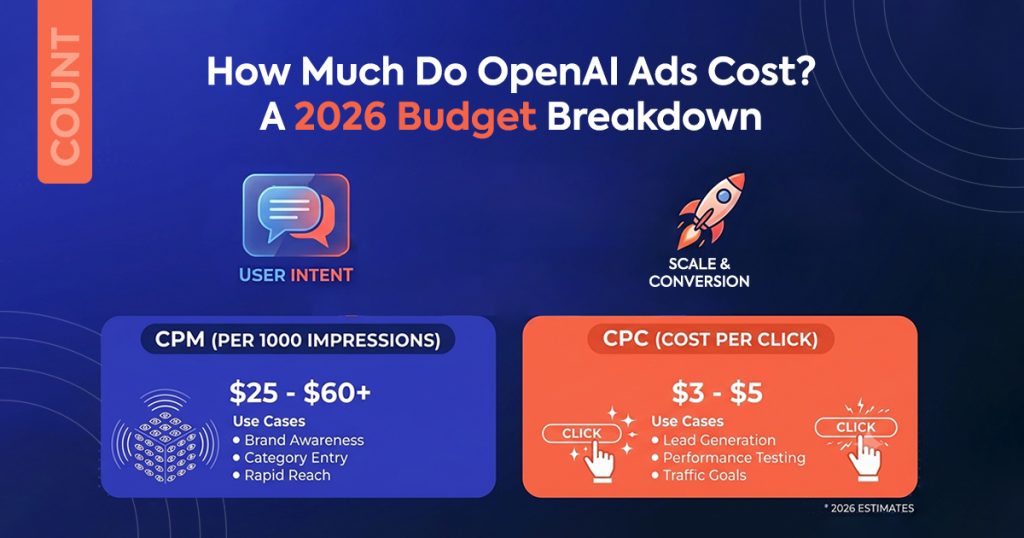
While pricing can vary by industry, audience, and campaign quality, early advertisers are generally seeing ranges like these:
| Metric | Typical Range |
| CPM | $25–$60 |
| CPC | $3–$5 |
| Daily Budget | $25–$100+ |
| Minimum Spend | No official minimum |
These numbers aren’t guarantees—they’re realistic planning figures that many early advertisers use when budgeting campaigns.
Understanding CPM
CPM means Cost Per 1,000 Impressions.
If your CPM is:
$30
then every 1,000 impressions costs approximately:
$30
Example:
Budget: $300
Average CPM: $30
Estimated impressions:
10,000
Higher-intent audiences often cost more because advertisers compete for valuable placements.
Understanding CPC
CPC means Cost Per Click.
If your campaign averages:
$4 CPC
and your daily budget is:
$50
you’ll receive approximately:
12–13 clicks per day.
Those clicks are typically higher intent than many social platforms because users are already asking purchasing questions.
What Does a Real Test Budget Look Like?
One of the biggest misconceptions is that you need thousands of dollars before trying OpenAI Ads.
In reality, many brands begin with a controlled test.
Small Test
Daily Budget:
$25/day
Monthly Spend:
Approximately $750
Goal:
- Validate audience
- Measure CTR
- Verify tracking
- Collect conversion data
This is often enough to determine whether OpenAI Ads deserve additional investment.
Growth Test
Daily Budget:
$50/day
Monthly Spend:
Approximately $1,500
Suitable for:
- Established Shopify stores
- Product launches
- Seasonal campaigns
- Multiple audiences
Scaling Budget
Daily Budget:
$100+
Monthly Budget:
$3,000+
Typically used when advertisers already have proven campaigns and reliable conversion tracking
OpenAI Ads vs Google Ads Budget
Many ecommerce teams compare OpenAI Ads with Google before deciding where to invest.
| Category | OpenAI Ads | Google Ads |
| Typical CPM | $25–60 | Often higher depending on industry |
| Typical CPC | $3–5 | Highly competitive keywords may cost much more |
| Competition | Lower | Very high |
| Buyer Intent | High conversational intent | High search intent |
| Learning Curve | New platform | Mature ecosystem |
Google still offers enormous reach.
However, OpenAI Ads give advertisers access to users during natural buying conversations instead of traditional search results.
Hidden Costs Most Businesses Forget
Ad spend isn’t the only cost involved.
Successful campaigns usually include:
- Conversion tracking
- Pixel installation
- Attribution
- Creative optimization
- Landing page improvements
- Reporting
- Campaign management
Without proper tracking, it’s impossible to know whether your campaigns are actually generating revenue.
Why Tracking Matters
Imagine spending:
$2,000
on OpenAI Ads.
You receive:
- 140 clicks
- 28 purchases
But your analytics only record:
16 purchases.
Suddenly your ROAS looks much worse than reality.
Incomplete attribution leads businesses to pause campaigns that are actually profitable.
That’s why accurate conversion tracking is one of the most important parts of any OpenAI Ads strategy.
Shopify + OpenAI Ads Pixel
If your store runs on Shopify, installing the OpenAI Ads Pixel should be one of the first steps before launching campaigns.
The pixel helps measure:
- Purchases
- Add to Cart
- Checkout Started
- Page Views
- Product Views
- Revenue
- Conversion Events
Accurate event tracking allows advertisers to understand which campaigns are driving actual sales—not just clicks.
Shopify Apps That Support OpenAI Ads Pixel
Several Shopify apps help merchants connect OpenAI Ads with their store.
1. UseCount (Recommended)
UseCount is designed specifically for OpenAI Ads conversion tracking.
Features include:
- One-click Shopify integration
- OpenAI Ads Pixel installation
- Server-side tracking
- Conversion API support
- Purchase attribution
- Revenue tracking
- Event deduplication
- Reliable reporting
Instead of manually configuring tracking, merchants can connect their Shopify store and begin measuring conversions in minutes.
2. Shopify Customer Events
Shopify’s native customer events framework can capture certain ecommerce interactions.
However, it generally requires additional configuration and doesn’t provide the dedicated OpenAI Ads tracking workflow that specialized apps offer.
3. Google Tag Manager (Advanced Setup)
Some businesses choose to configure OpenAI Ads tracking through Google Tag Manager.
While flexible, this approach often involves:
- Custom JavaScript
- Event mapping
- Manual testing
- Ongoing maintenance
For many merchants, a purpose-built Shopify app is faster and easier to manage.
How Much Should Ecommerce Brands Budget?
A practical starting point depends on the stage of your business.
| Store Size | Suggested Monthly Budget |
| New Store | $750–$1,000 |
| Growing Brand | $1,500–$3,000 |
| Established Ecommerce Brand | $3,000–$10,000+ |
The goal isn’t to spend the most—it’s to gather enough data to optimize campaigns and scale what works.
When Should You Hire an OpenAI Ads Team?
Managing OpenAI Ads involves more than setting a daily budget.
A managed team can help with:
- Campaign strategy
- Audience targeting
- Creative testing
- Conversion tracking
- Shopify implementation
- Performance optimization
- Reporting and attribution
If you’re investing several thousand dollars each month, expert management can often improve efficiency and reduce wasted spend.
Best Practices for Keeping Costs Under Control
To maximize your advertising budget:
- Start with a small daily budget.
- Verify that conversion tracking is working before scaling.
- Optimize landing pages for faster conversions.
- Monitor CPC and CPM trends regularly.
- Focus on high-intent audiences.
- Scale gradually based on real performance data.
- Review attribution reports before making budget decisions.
Final Thoughts
OpenAI Ads are still in the early stages, giving businesses an opportunity to reach high-intent shoppers before competition increases.
While costs vary by industry and campaign quality, many advertisers begin testing with around $25 per day, monitor performance, and scale once they have reliable conversion data.
Just as important as your budget is your ability to measure results. Without accurate tracking, it’s difficult to know which campaigns are driving revenue and which need improvement.
If you’re running a Shopify store, combining a realistic test budget with reliable OpenAI Ads Pixel tracking can give you the confidence to optimize campaigns and grow efficiently.
Continue Learning
If you’re new to OpenAI Ads, read our complete guide:
OpenAI Ads for Ecommerce: The Early Movers Guide (2026)
It covers campaign strategy, setup, targeting, and best practices for merchants looking to get started.
Frequently Asked Questions
Is there a minimum budget for OpenAI Ads?
There is currently no official minimum spend, but many advertisers start testing with around $25 per day.
What is a typical OpenAI Ads CPC?
Many early campaigns report CPCs in the range of $3–$5, though this can vary depending on targeting and competition.
What CPM should I expect?
A reasonable planning range is $25–$60 CPM, but actual costs depend on your campaign and audience.
Can Shopify stores track OpenAI Ads conversions?
Yes. By installing the OpenAI Ads Pixel through a compatible Shopify integration such as UseCount, merchants can track purchases, revenue, and other key conversion events.
Should I increase my budget immediately?
It’s generally better to validate tracking and campaign performance with a smaller budget first, then scale once you have reliable conversion data.