You’ve done everything the playbook told you to. You wrote sharper creative. You tightened your audiences. You raised bids on the winners and cut the losers. And still, month after month, the algorithm spends your budget on people who don’t buy — window shoppers, one-click bouncers, the endlessly-adds-to-cart-never-checks-out crowd.
The reflex is to blame the targeting settings. Test a new lookalike. Narrow the interests. Try broad. Try manual. You tinker with the dials on the dashboard because it’s what you can see.
But the dials aren’t the problem. Ad algorithm targeting is downstream of something you probably haven’t looked at in months: the quality of the conversion data you feed it. Modern platforms don’t target based on your settings so much as they target based on your signals — and if those signals are incomplete, no amount of dial-turning will save you. Garbage in, wrong people out.
This post explains the actual mechanism — how flawed conversion data misdirects the algorithm on every platform, why the failure stays invisible on your dashboard, and why fixing your measurement foundation beats every targeting tweak you could make.
How Ad Algorithms Actually Decide Who to Target
Start with a correction, because the whole industry talks about targeting wrong.
When you set up a campaign, you feel like you’re choosing the audience. In reality, on Meta, Google, TikTok, and now OpenAI Ads, you’re choosing a starting constraint — and then the machine-learning system takes over. It watches who converts, builds a statistical profile of those people, and spends the rest of your budget finding more of them.
The feedback loop is the product
Every ad platform runs the same core loop:
- It shows your ad to a batch of people.
- Some of them convert.
- It reports those conversions back into the system.
- The model studies the converters and adjusts who it shows the ad to next.
- Repeat, thousands of times a day.
That loop is the entire engine. Your creative and your bids influence it, but the fuel is the conversion signal — the data that tells the model which impressions turned into sales. The model only ever gets as smart as the definition of “converter” you hand it.
Which means your data is your targeting
Here’s the uncomfortable conclusion. If your conversion signal is complete and accurate, the model learns from a true picture of your buyers and gets better every day. If your signal is partial or biased, the model learns from a distorted picture — and gets confidently worse, because it has no way to know the picture is distorted. It optimizes hard toward a version of your customer that doesn’t fully exist.
Ad algorithm targeting isn’t a settings problem. It’s a data problem wearing a settings costume.
The Hidden Flaw: Your Conversion Signal Carries Bias, Not Just Gaps
Most merchants who learn their pixel misses conversions assume the damage is a smaller number. Fewer conversions reported, lower ROAS, done. That framing badly understates it.
The real damage isn’t that you lose some data. It’s that you lose data in a non-random way. If you haven’t already read the full breakdown, we covered why browser pixels lose your best customers in detail — but here’s the short version.
Missing conversions cluster on a specific type of buyer
Think about who your browser pixel fails to record. It misses:
- iOS users, because Apple’s Intelligent Tracking Prevention expires the cookies that tie their purchase to the click.
- Ad-blocker users, because the pixel request never leaves their device.
- Cross-device shoppers, because the browser can’t connect the phone that clicked to the laptop that bought.
- Privacy-conscious buyers generally, because every browser default now leans their way.
Notice what those groups have in common. They skew younger, more affluent, more tech-literate, more mobile-first — frequently the highest-value segment of your entire customer base. The conversions you lose aren’t a random 30% sample. They’re a specific 30%, packed among the exact people you’d most want more of.
So the model learns the wrong lesson
Now run that through the feedback loop. The algorithm only sees the conversions that did land — the ones from older desktop users on Chrome with no ad blocker who bought on the first session. It concludes those people are your buyers. It goes and finds more of them. And it systematically avoids the mobile-first, privacy-protected, high-value segment, because as far as its data shows, those people never convert.
You didn’t just lose reporting accuracy. You taught your ad optimization engine to actively discriminate against your best customers. Every day it runs, it gets more precisely wrong.
Why This Stays Invisible on Your Dashboard
If this were happening, surely you’d see it? You wouldn’t, and the reasons deserve understanding.
The numbers look plausible
Nothing turns red. A biased dataset produces a perfectly normal-looking dashboard — real conversions, believable ROAS, a cost-per-acquisition in the range you expect. No error state exists for “the conversions I’m showing you are the wrong ones.”
The algorithm hides its own blind spot
The model can’t report a problem it can’t perceive. It doesn’t know it’s missing the iOS buyers, so it never flags them. From inside the system, everything looks like it’s working — the reported conversions convert, the model optimizes toward them successfully. The failure lives entirely in the gap between what happened and what the system recorded, and no dashboard can show you a gap.
The symptoms mimic other problems
When performance stalls, the missing-signal explanation never surfaces, because the symptoms look like more familiar villains. Rising CPA looks like auction competition. Plateauing scale looks like a saturated audience. Weak new campaigns look like creative fatigue. You chase those, because those are the stories the industry tells. The conversion data quality issue underneath never enters the conversation.
Why Better Targeting Settings Can’t Fix a Data Problem
This part saves you months of wasted effort, so sit with it.
Every targeting lever you can pull operates on top of the conversion signal, not underneath it.
A better audience still learns from bad data
Build a pristine lookalike, and the platform builds it from your converter list — which is your biased converter list. The lookalike faithfully resembles the wrong people. You’ve made the model more efficient at finding more of the segment you didn’t want to over-weight.
Broad targeting hands the algorithm more rope
“Go broad and let the algorithm figure it out” is sound advice — but only when the algorithm holds a true signal to figure things out with. Feed a broad campaign a biased signal, and it explores the whole audience, then narrows hard onto the trackable-buyer cluster, because that’s the only place it sees conversions. Broad targeting amplifies a good signal and amplifies a bad one just as efficiently.
Manual bidding can’t out-think missing data
You can bid up the segments you believe are valuable, but now you’re fighting your own conversion data by hand, permanently, on every campaign. That’s not a strategy. It’s a symptom you’ve decided to manage instead of cure.
The pattern holds across every lever: you cannot tune your way out of a foundation problem. The settings sit on top of the data. Fix the data, or keep decorating the crack.
Fix the Foundation: Feed the Algorithm a Complete Signal
There’s exactly one durable fix, and it’s structural rather than tactical. Give the model a conversion signal that captures every buyer, not just the trackable ones.
Move the money event off the browser
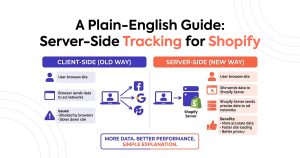
The conversions you lose all share one cause — they depend on the browser to report themselves, and the browser has become an unreliable narrator. A server-side setup removes that dependency. When Shopify records an order, the order webhook fires the conversion directly from Shopify’s infrastructure to the ad platform’s Conversions API. No browser, no expiring cookie, nothing for an ad blocker to intercept.
That single change closes the bias at its source. The iOS buyer, the ad-blocker user, the cross-device shopper — the server records them all identically, because it confirms the purchase from the order record rather than from a fragile script in their browser.
Don’t introduce a new problem while fixing the old one
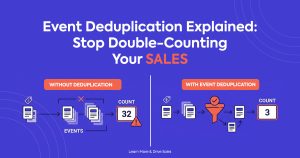
A complete signal only helps if each sale counts once. The moment you run both a browser pixel and a server-side feed, you risk double-counting every conversion the browser does catch. We unpacked exactly how to stop double-counting before you scale spend in a separate walkthrough — the short answer is a shared event_id that you derive from the Shopify order ID and deliver on both tracks, so the platform deduplicates automatically.
What the algorithm does with a clean signal
Feed the model a complete, unbiased converter list and the feedback loop finally works in your favour. It sees your actual buyers — mobile-first and desktop, privacy-protected and not, first-session and cross-device. It builds lookalikes from the real population. It stops avoiding your high-value segment because it can finally see them convert. The same algorithm that was confidently wrong becomes confidently right, and every downstream lever — audiences, bids, budget — now operates on truth instead of a distortion.
You don’t get better targeting by tuning targeting. You get it by fixing what targeting learns from.
How Count Rebuilds Your Signal Foundation
Rebuild your conversion signal with Count — it installs your ad pixel server-side on Shopify in one click and hands the algorithm the complete picture it’s been missing.
What it does for your targeting
It captures the buyers your pixel loses. See how server-side delivery captures every buyer — Shopify’s servers confirm every purchase, so iOS, ad-blocker, and cross-device conversions all reach your ad platform. The measured result across live stores: a 99.4% conversion match rate against actual Shopify orders, versus roughly 64% browser-only. That recovered 35% falls disproportionately in your high-value segment — the exact data the model needs to stop mistargeting.
It deduplicates automatically. Count matches browser and server events by Shopify order ID, so a complete signal doesn’t become a double-counted one. The model gets each buyer once, accurately.
It sends exact values. Discounts, currency, and refunds land precisely, so the algorithm optimizes toward real revenue rather than a browser’s rough guess — which matters enormously for value-based bidding.
It respects consent. Count reads Shopify’s Customer Privacy API and only sends events for shoppers who consented, so you rebuild signal quality without opening a compliance gap.
It starts free. The full server-side pixel with deduplication ships on every plan, including the free tier. Accuracy isn’t the upsell — it’s the product.
Done-for-you, if you’d rather not run it yourself
Fixing the signal is step one. Rebuilding campaigns on top of clean data is step two, and it’s a different skill. The team behind Count doesn’t just ship the tracking — Count’s managed OpenAI Ads service covers setup, launch, and daily management on that same server-side foundation. The team handles creative, copy, bidding, and optimization so you don’t have to.
It starts with a free readiness audit: the team measures your real conversion gap before you spend another dollar, so you can see exactly how much of your targeting problem is really a data problem. Book a free readiness audit →
Install Count free on Shopify →
The Bottom Line
Your ad algorithm isn’t broken, and it isn’t stupid. It does precisely what you built it to do — learn from the conversions you report and find more people like them. The problem is that you’ve reported the wrong conversions, so it’s been finding the wrong people, flawlessly, for months.
No lookalike, bid strategy, or audience refinement fixes that, because all of them learn from the same distorted signal. The only durable move is to repair the foundation: capture every buyer, feed the model a true picture, and let a system that was confidently wrong become confidently right.
Fix the data first. Then, and only then, does the targeting take care of itself.
Frequently Asked Questions
Q1: Why does my ad algorithm keep targeting people who don’t convert?
Usually because your conversion signal carries bias, not because your settings are wrong. Ad platforms learn who to target from the conversions you report. If your pixel misses a specific slice of buyers — typically iOS, ad-blocker, and cross-device users — the algorithm never learns those people convert, so it chases the trackable segment instead and avoids some of your best customers.
Q2: How does conversion data quality affect ad targeting?
Directly and completely. Machine-learning ad platforms build their entire targeting model from your reported conversions. High-quality, complete data teaches the model an accurate picture of your buyers. Biased or partial data teaches it a distorted one — and because the model can’t perceive its own blind spot, it optimizes confidently toward the wrong audience.
Q3: Will a better lookalike audience fix my targeting problem?
Not if the underlying data carries bias. A lookalike mirrors your existing converter list, so if that list systematically excludes your high-value mobile and privacy-protected buyers, the lookalike resembles the wrong people. Better audiences sit on top of your conversion signal — they can’t repair it.
Q4: Why doesn’t my dashboard show that the algorithm is mistargeting?
Because a biased dataset produces a normal-looking dashboard. The conversions you do record are real, so ROAS and CPA look plausible. The failure lives in the gap between what happened and what the system recorded, and no dashboard displays a gap. The symptoms also mimic auction competition, audience saturation, and creative fatigue, so the real cause rarely surfaces.
Q5: How do I feed the algorithm a complete conversion signal?
Move the purchase event off the browser and onto the server. A server-side setup confirms each sale from Shopify’s order webhook rather than a browser script, so it captures the iOS, ad-blocker, and cross-device buyers that browser pixels lose. That gives the algorithm an unbiased converter list to learn from. An app like Count installs this in one click on Shopify.
Q6: How long until targeting improves after I fix my tracking?
Expect the model to re-learn over its optimization window — often one to two weeks of steady conversion volume — as the newly captured buyers enter the feedback loop. The improvement compounds: each cycle, the model sees more of your true audience and refines toward it, rather than toward the trackable-only slice it relied on before.